
· Dana Whitfield
Do cats need collars? And when a kitten can wear one
The collar question splits owners more than any other piece of cat equipment, and the disagreement is almost always about the wrong thing. People argue about whether a cat should wear a collar. The thing that actually decides whether a collar is safe or dangerous is what happens when it catches on something.
Does an indoor cat need one?
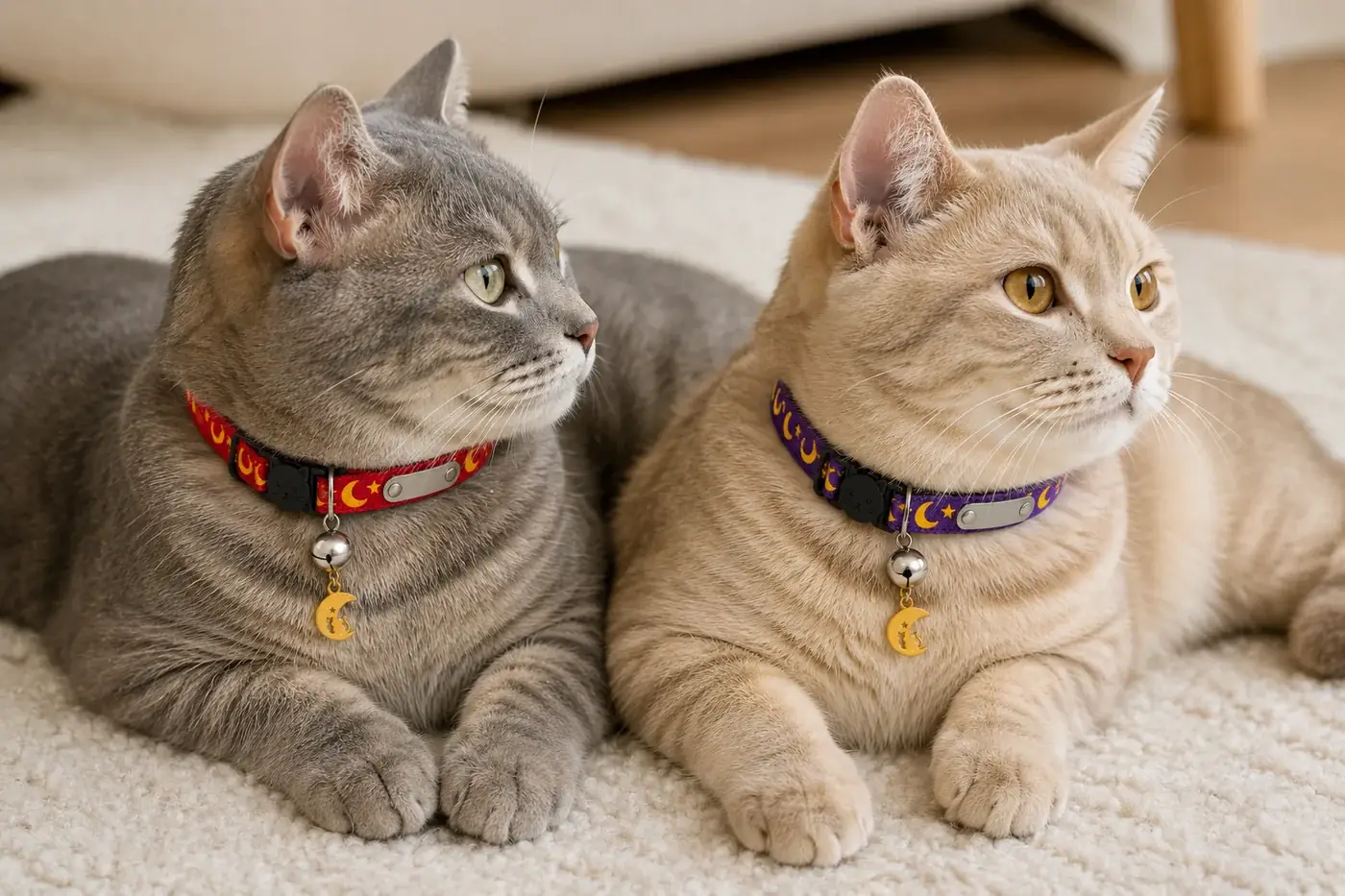
This is where most people say no, and it is the case where a collar earns its keep most quietly. An indoor cat has no road sense, no territory, and no experience of being outside. If she gets out — a delivery, a window left open, a move, a fire alarm — she does not come back the way an outdoor cat does. She goes somewhere small and hides.
And when a neighbor finally finds her, the thing that decides what happens next is whether she looks owned. A cat with no collar looks like one of the hundreds of unowned cats in any neighborhood, and gets fed rather than reported. A cat with a plate on her neck gets a phone call.
The counter-argument — that a collar is a risk indoors — is a real one, and it is answered by the buckle rather than by leaving the collar off. More on that below.
At what age can a kitten wear a collar?
Around eight weeks is the usual starting point, and the real gate is not age but neck. You need a neck that has stopped being a soft tube, and a collar that adjusts small enough to sit correctly on it — a collar that has to be fastened on its very last hole is the wrong size, not a small setting.
| Age | Typical neck | What to do |
|---|---|---|
| Under 8 weeks | Still changing weekly | Wait. Nothing gained by starting early |
| 8–12 weeks | 6 – 8 in | First collar, checked weekly |
| 3–6 months | 7 – 9.5 in | Check every fortnight, expect one size change |
| 6–12 months | 8 – 11 in | Settles. Check monthly |
| Adult | 8 – 13 in | Check at every grooming or weight change |
Neck ranges are a guide. Measure the cat you have, with one finger flat underneath.
Kittens grow fast enough that a collar fitted correctly in March can be tight in May. The check is one finger, flat, slid between strap and coat — two on a dog, one on a cat, because a cat's neck is a fraction of the size.
The buckle is the whole safety question
A cat climbs, squeezes through gaps and jumps onto things with hooks on them. A collar that cannot come off under load is genuinely dangerous, and that single fact is the origin of every horror story owners have heard.
A breakaway buckle answers it mechanically: put enough force on the strap and the two halves separate, the collar drops, the cat walks away. Nothing about the cat, the strap or the fit changes that behavior — it is in the buckle. That is why the question "is a collar safe for a cat" has no general answer, only a per-buckle one.
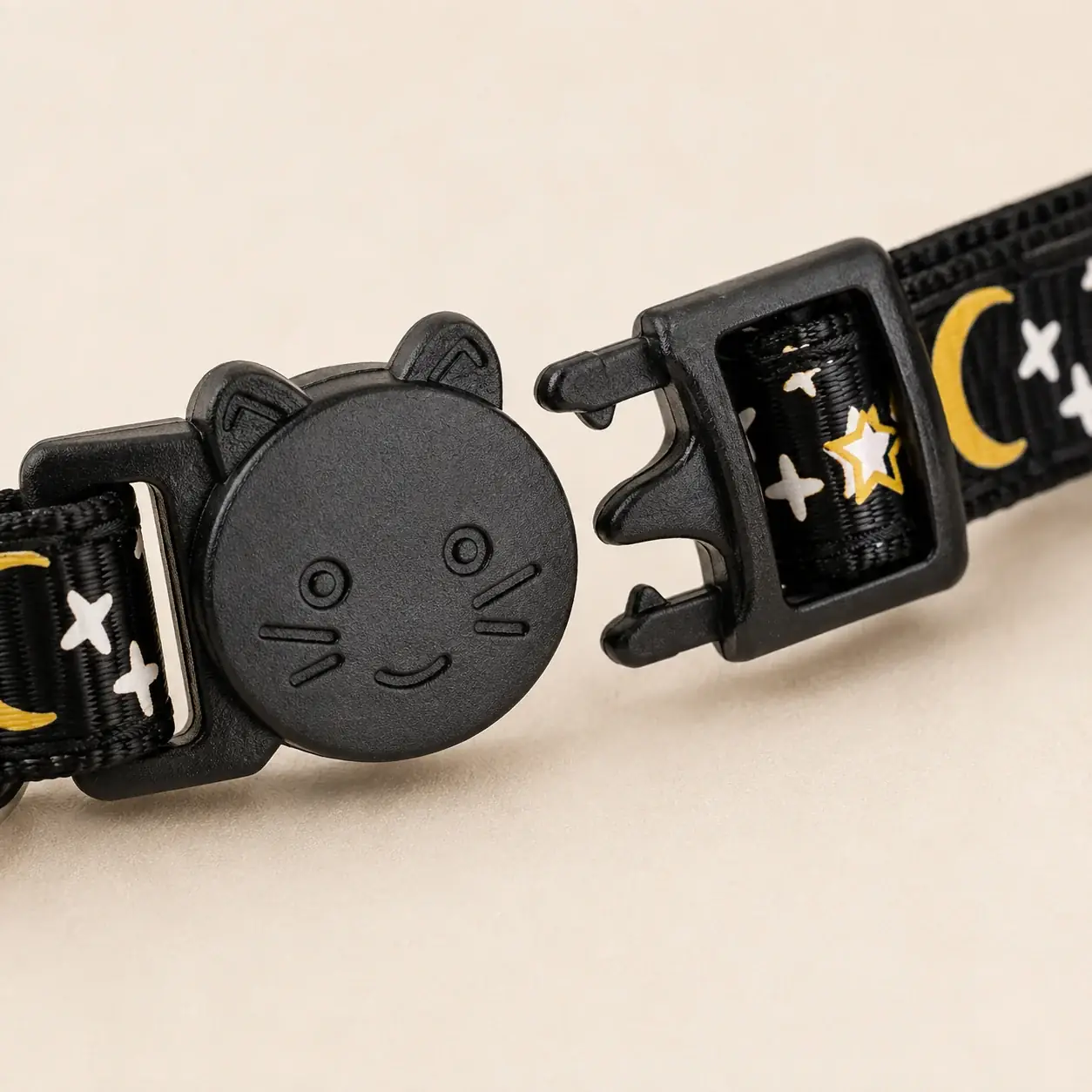
The mechanism, the release force and what to do when it opens too readily are covered on our breakaway cat collar page, which is also where the engraved plate lives.
Do vets recommend cat collars?
Broadly yes, with the same condition attached every time: breakaway only. The veterinary position on collars is not really a position on collars at all — it is a position on identification. A cat brought into a practice with a plate on her neck is reunited in an afternoon; one brought in with nothing is a scanning job, a database query, and often a stay.
The other point vets make consistently is that a collar and a microchip do different jobs and neither replaces the other. The chip is permanent and needs a scanner and a working registry entry. The plate is readable by the neighbor holding the cat, right now, with no equipment.
What to use instead of a collar
The three alternatives people ask about, and what each actually does:
| Alternative | Does | Does not |
|---|---|---|
| Microchip | Permanent, survives everything | Needs a scanner and a current registry entry |
| GPS tracker | Tells you where she is | Needs charging, and hangs off a collar anyway |
| Nothing at all | No catch risk | Makes an owned cat look unowned |
The GPS row is the one worth reading twice. Trackers are useful and they are not a substitute, because almost all of them attach to a collar — so the question of whether your cat wears a collar is settled before the tracker arrives. A tracker on a breakaway collar also comes off with the collar, which is the correct trade but worth knowing.
If you genuinely cannot have a collar on your cat, a chip plus a current registry entry is the fallback, and the registry entry is the part that fails. A study of 7,704 microchipped animals across 53 shelters, published in 2009, found chipped strays went home 52.2% of the time against 21.9% for strays overall — and the failures were overwhelmingly stale contact details rather than missing chips.
My cat keeps taking her collar off
Two different things get reported as this, and they have opposite fixes.
The collar is found on the floor, intact, buckle open. The breakaway is releasing, and the usual cause is a collar fitted loose enough to snag on her own jaw when she scratches. Tighten to one finger, flat. Counter-intuitive, but a correctly fitted breakaway releases far less often than a loose one.
The collar is off and she is unbothered. Some cats will work at a collar for the first few days. The reliable approach is short sessions with something she likes happening while it is on, rather than putting it on and leaving the room. Most cats stop noticing it within a week; the ones who do not usually have a fit problem rather than an opinion.
Without a bell?
A bell is a separate decision from the collar and from the buckle. It exists to give birds a warning and to tell you where the cat is; some cats are visibly bothered by it and some ignore it entirely. If yours is bothered, the bell comes off — it is attached to a ring, not built into the strap, and removing it changes nothing about the safety of the collar.
What goes on the plate
The same rule as for a dog, tightened by the smaller surface: one phone number you actually answer, and the cat's name if there is room. Not your address. Not "I am chipped" — that is a sentence for you, not for the person holding your cat and looking for a way to reach a human being.
A riveted plate is worth more than a hanging disc on a cat specifically, because a dangling tag is one more thing to catch, and a plate lying flat against the strap is not. The full reasoning is in what to put on an ID tag — it applies to cats without modification.
The short version
Outdoor cat: yes, with a breakaway buckle. Indoor cat: yes, for the day the door is open, with a breakaway buckle. Kitten: from about eight weeks, checked weekly while she grows. And whatever else you decide, the thing on the strap should be a phone number, because that is what turns a found cat into a cat that comes home.

Dana Whitfield · Curator, Namouf
Dana writes the sizing guidance and the guides on this site.