
· Dana Whitfield
Dog collar size chart: how to get it right the first time
A breed chart tells you what the breed usually measures. A tape measure tells you what your dog measures, and only one of those two goes around his neck. Breed tells you very little. Two Labradors of the same age can be two inches apart at the neck, and a heavy-coated dog measures wider in winter than the same dog in July.
The chart
These ranges are given in inches and rounded inward at every boundary. That matters: it means a dog sitting at the top of a range is genuinely at the limit rather than comfortably inside it.
| Size | Neck | Strap width | Typical dog |
|---|---|---|---|
| XS | 7 – 10.5 in | 0.6 in | Chihuahua, Yorkshire Terrier, small puppy |
| S | 9 – 12.5 in | 0.6 in | Miniature Dachshund, Shih Tzu, Papillon |
| M | 11 – 14.5 in | 0.8 in | Beagle, Cocker Spaniel, French Bulldog |
| L | 13.5 – 17.5 in | 1 in | Border Collie, Australian Shepherd, Boxer |
| XL | 17 – 21.5 in | 1.2 in | German Shepherd, Labrador, Golden Retriever |
The breed column is a starting point, not an answer. Measure the dog you have.
How to measure, in one minute
Use a soft tailor's tape. If you do not own one, a strip of string and a ruler works just as well.
- Have your dog stand rather than sit. A sitting dog folds his neck and reads short.
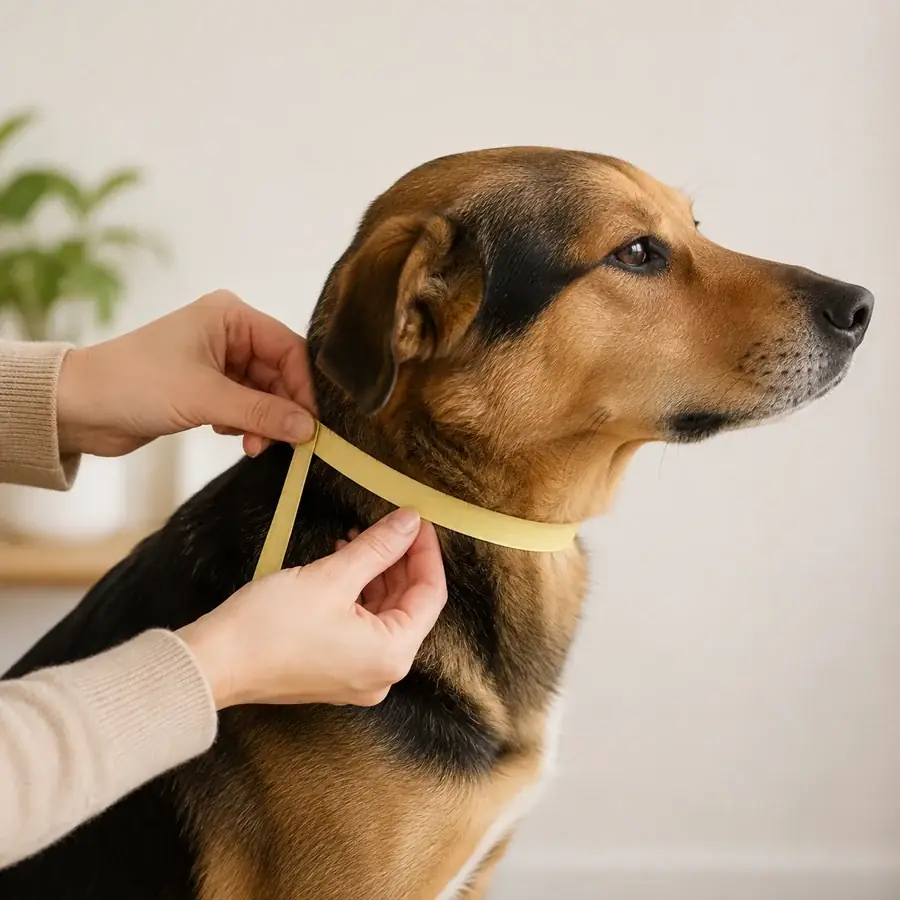
- Run the tape around the base of the neck, where the collar naturally settles, not up under the jaw.
- Slide two fingers flat between the tape and the coat, and keep them there while you read.
- Read the number in inches at the point where the tape meets.
The two fingers are the whole trick. They are what turns a measurement of the neck into a measurement of the collar, and they are why a tape pulled snug gives you a collar that will not fit.
How many fingers should fit under a dog collar?
Two, flat and together, on a dog of any size above small-breed. One finger on a cat or a very small toy breed, because the whole neck is a fraction of the size. The word doing the work is flat: turned edgewise, two fingers slide under almost any collar and the test tells you nothing.
What size collar for a 20, 25 or 30 pound dog?
Weight is the shortcut everyone reaches for, and it is the least reliable input on this page. A 30 pound beagle and a 30 pound whippet are two different necks, and the whippet is the one a weight chart gets badly wrong. Use this to sanity-check a measurement, never to replace one.
| Weight | Neck, typically | Usual size |
|---|---|---|
| Under 10 lb | 7 – 10 in | XS |
| 10 – 20 lb | 9 – 12.5 in | S |
| 20 – 30 lb | 11 – 14.5 in | M |
| 30 – 55 lb | 13.5 – 17.5 in | L |
| 55 lb and up | 17 – 21.5 in | XL |
Sighthounds run one size down on this table and flat-faced heavy breeds run one size up. Measure.
What does a "12 inch" or "20 inch" collar mean?
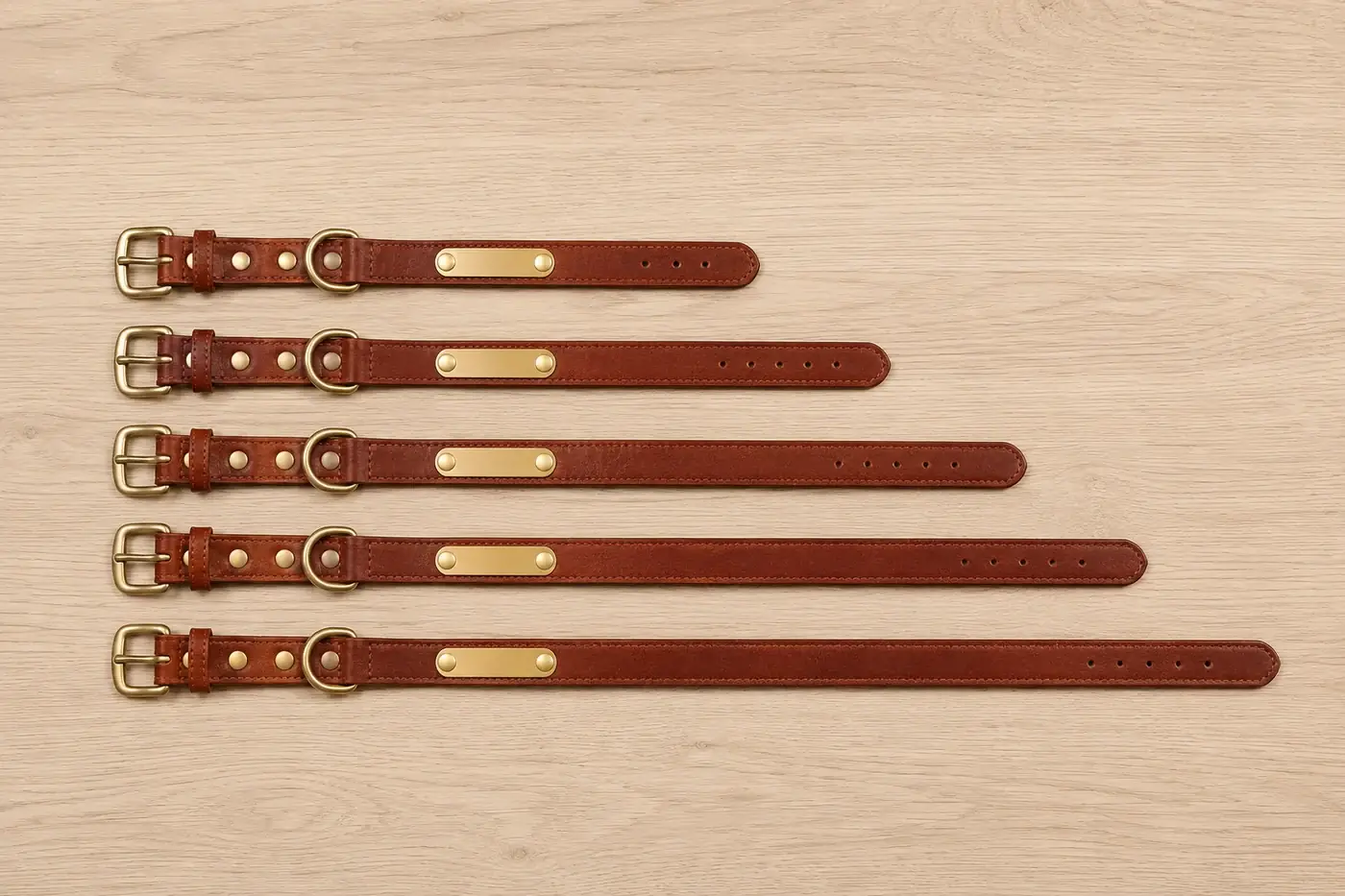
It refers to the neck it fits, not the length of the strap — the strap is always longer, because it has to pass through the buckle and lie under the keeper. So a 12 inch collar is one that closes correctly around a 12 inch neck, and it will physically measure around 15 or 16 inches laid flat.
Read across from the neck column in the chart above. A 12 inch neck sits in our M, a 20 inch neck in our XL. And "what size is an XL" has the same answer from the other direction: 17 to 21.5 inches at the neck, on a 1.2 inch strap.
Sized up or sized down?
Up, in every case except one. The holes in a buckle only extend the range in one direction from where you land, and the direction you need is looser: a thicker winter coat, a few extra pounds, a dog still growing. The exception is a fully grown dog sitting at the very bottom of the larger size, where the smaller one holds the plate flatter — covered in the section below.
What to do when your dog lands between two sizes
Take the larger one. This is not a hedge. A collar sits in a range because the buckle has several holes, and the useful part of that range is above the number you measured, not below it. A dog at 14.5 inches in a size that stops at 14.5 has exactly one hole that works, and no room for a thicker winter coat or a few extra pounds.
There is one exception. If your dog is at the very bottom of the larger size and fully grown, the smaller size will hold the plate flatter against the neck. A collar that rotates puts the engraving face down in the fur, which defeats the point of having it.
What an S and an L look like on a dog
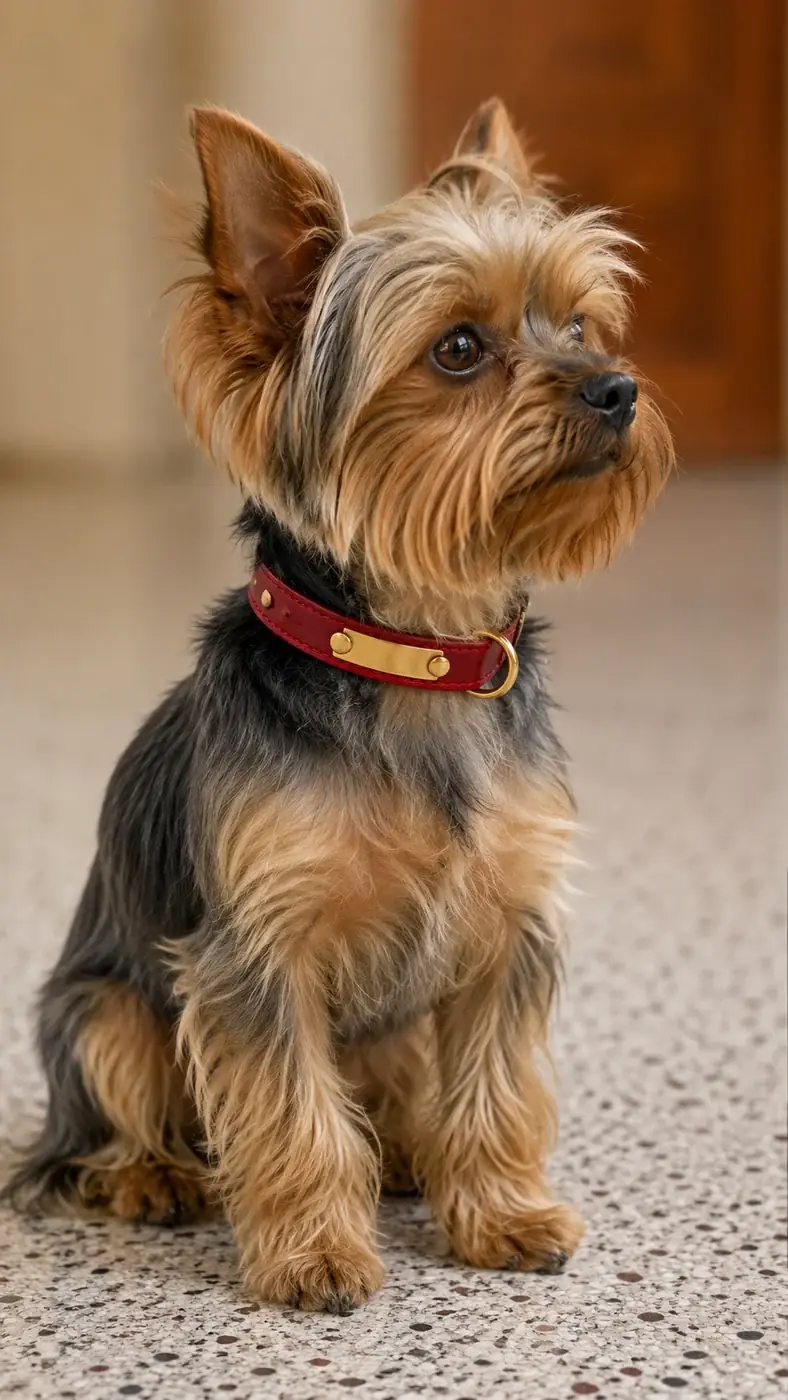
A chart in inches settles the measurement, not the doubt. The two sizes people hesitate over are the ones either side of the middle: S, where a small dog is often between the puppy size and the adult one, and L, where the strap gets wider at the same time as it gets longer and starts to look like a different object.
Puppies are a different problem
A puppy under a year will usually outgrow his first collar within a few months, and there is no way to buy around it. Buying large and cinching it to the last hole produces a loose band that rotates, slides forward toward the ears and comes off over the head at the worst possible moment.
Buy the size that fits today, check the fit every two weeks with the same two fingers, and expect to buy once more before the first birthday. For most medium breeds that means an S or M at twelve weeks and an L by ten months.
Strap width is part of the fit
Width is the column most charts leave out, and it changes how the collar behaves. A 0.6 inch strap on a small dog distributes pressure adequately and stays light. The same 0.6 inch strap on a shepherd cuts a narrow line into the coat and puts all the pull on a thin band. Our sizes step up in width along with neck length for that reason: 0.6 inch through S, 0.8 at M, 1 inch at L and 1.2 at XL.
If your dog pulls hard on the lead, the wider strap in the larger size is doing real work. It is also the reason a collar bought two sizes up "so it lasts" is a worse collar and not just a looser one.
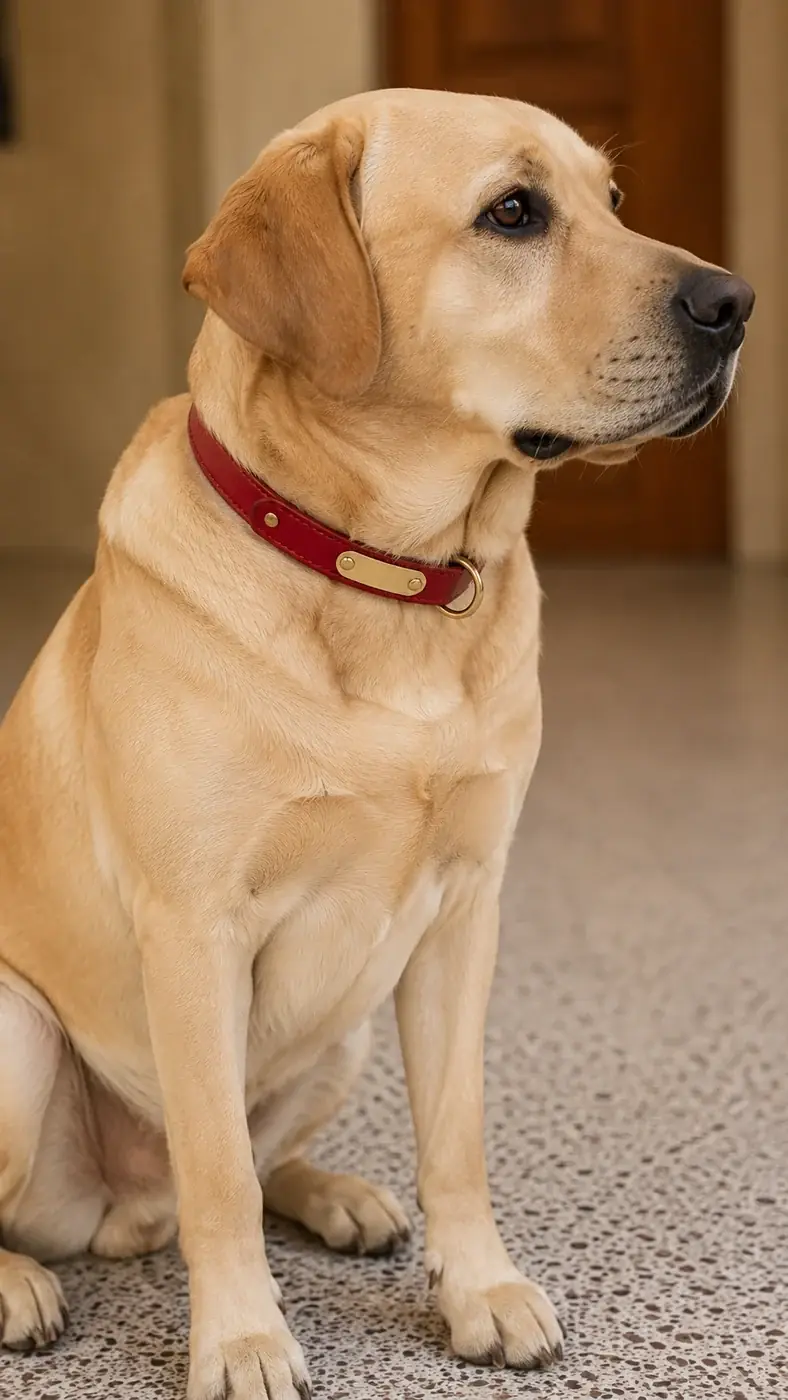
Put the two side by side and the width does most of the talking. The same collar in S sits as a thin band on a terrier; in L it reads as a proper strap on a labrador, and that is the difference the neck measurement alone never tells you.
When to re-measure
Three moments are worth a check: at the change of season on a double-coated breed, after any significant weight change, and any time you can slide more than two fingers under the strap without effort. A collar that has quietly loosened is the one a dog backs out of on a walk.
What a size chart cannot tell you
Two things fall outside any table. The first is head shape. On a sighthound, a whippet or an Italian greyhound, the skull is barely wider than the neck, so a collar fitted by the two-finger rule can still slide off over the ears when the dog reverses. Those breeds need either a snugger fit checked far more often, or a collar shaped to widen at the throat.
The second is coat density. A double-coated dog measured in February and the same dog measured in July can be three quarters of an inch apart, and the tape does not know which one you are holding. Push the tape gently down to the skin on a thick coat and note both numbers, because the winter figure is the one that decides whether the last hole is enough.
Measuring a dog that will not stand still
Most fit problems trace back to a bad measurement rather than a bad chart. If your dog treats the tape as a game, take the measurement while he is eating, or measure a collar that already fits and read it flat on the table instead: lay it out, measure from the buckle pin to the hole currently in use, and you have the number without touching the dog at all. That figure is directly comparable to the neck column above.

Dana Whitfield · Curator, Namouf
Dana writes the sizing guidance and the guides on this site.