· Dana Whitfield
How to clean a leather dog collar
A leather collar is worn twenty-four hours a day against skin and fur, which is a harder life than most leather goods ever see. It also survives that life better than anything else, provided nobody tries to clean it the way they would clean a floor.
Are leather collars good for dogs?
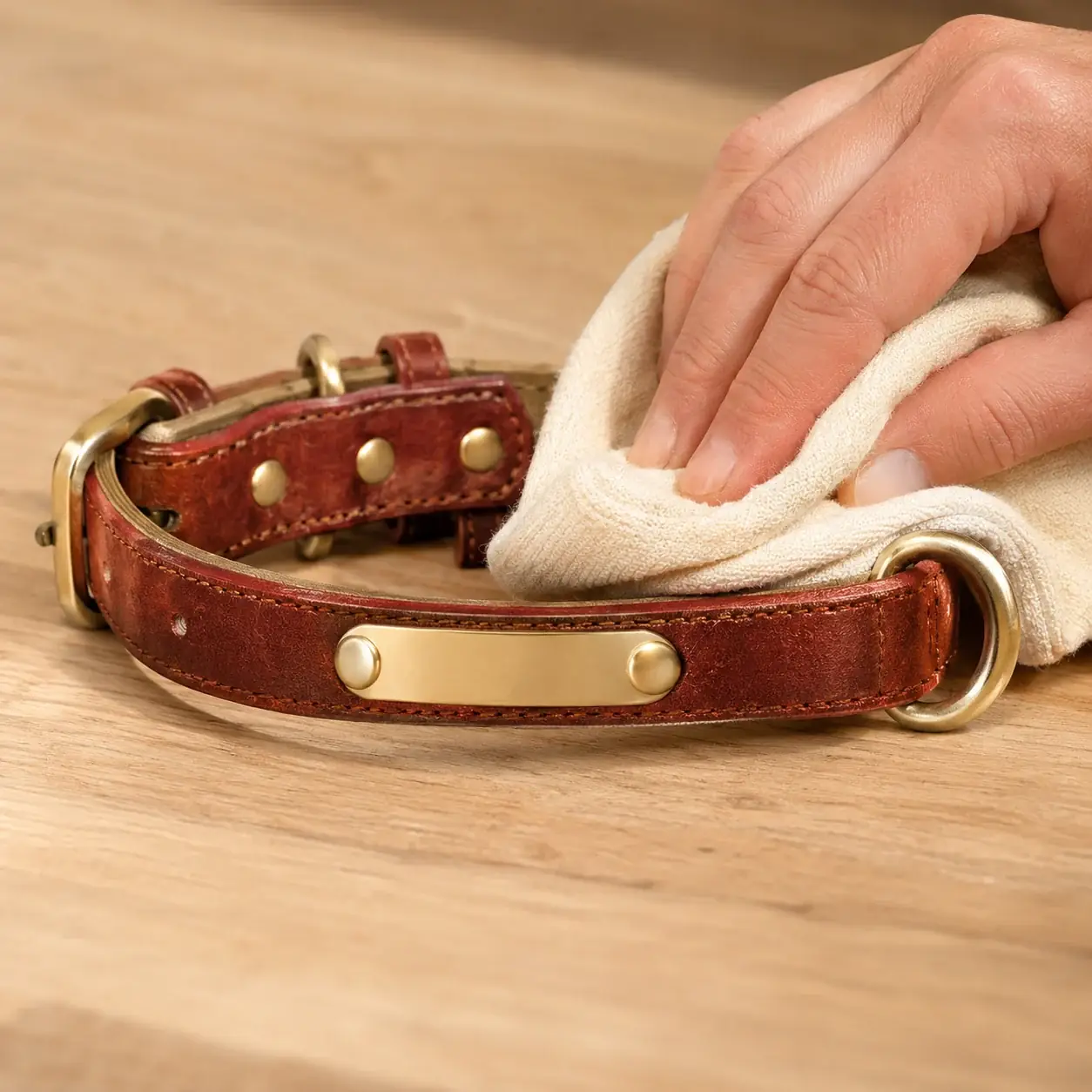
For a collar worn permanently, it is the material with the fewest drawbacks, and the reasons are practical rather than aesthetic.
- It softens to the dog rather than staying rigid. Webbing is the same shape on day one and day nine hundred. Leather takes the curve of that particular neck within a fortnight, which is why long-term chafing is uncommon on a well-fitted one.
- It does not hold odour the way woven synthetics do. Webbing traps moisture in the weave and keeps it. A sealed surface has nowhere for it to sit.
- It fails slowly and visibly. Leather cracks and thins where you can see it. Stitching on webbing goes without warning.
- It carries a riveted plate properly. A plate needs a substrate that will not tear around the rivet under load.
Water is the one thing worth staying on top of. A collar on a dog who swims wants a wipe and a slow dry afterwards, which takes about a minute, and the section below covers exactly how. Everything else about the material is in the collar itself.
The routine, in three steps
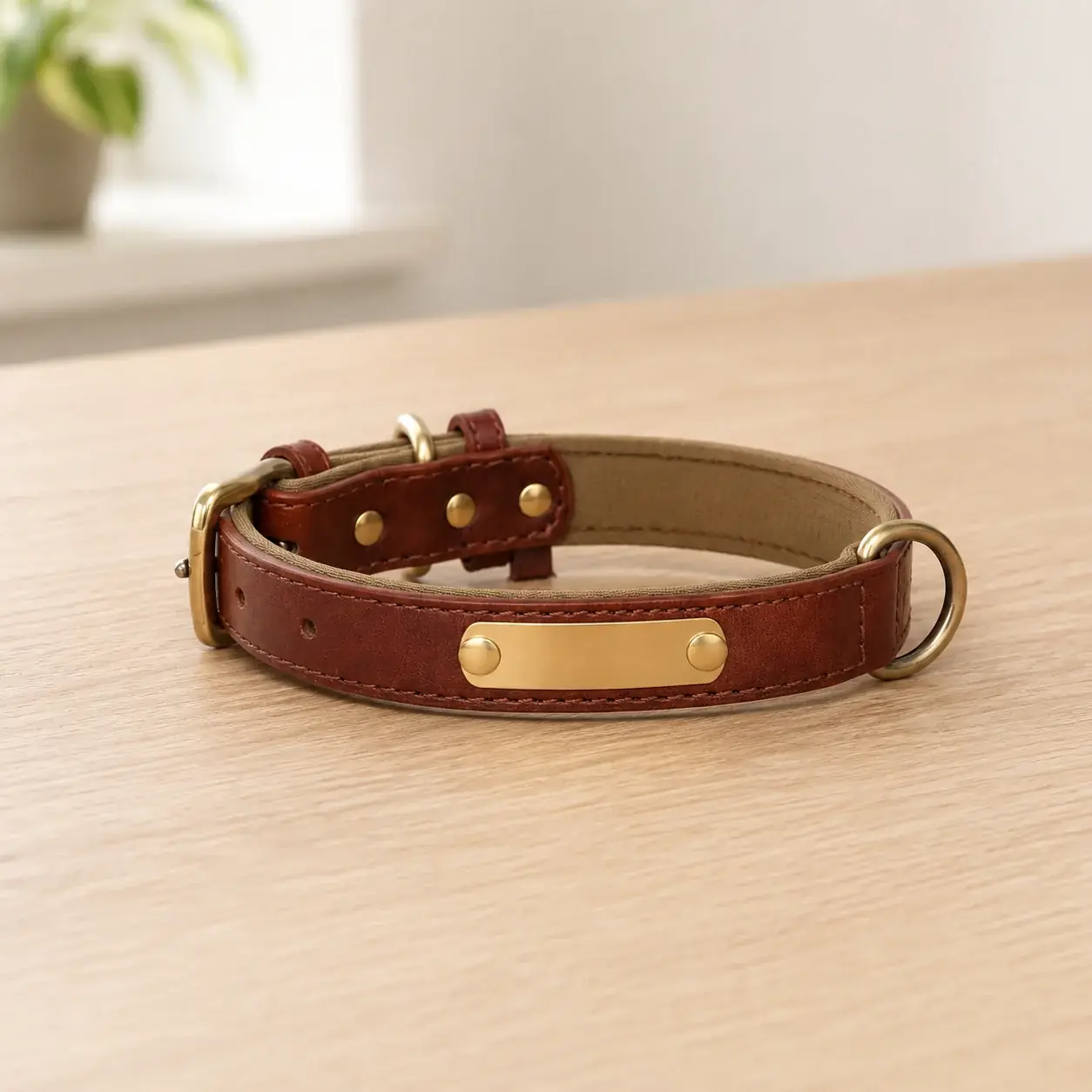
- Wipe. Take the collar off. Use a soft cloth, barely damp — wrung out until it feels cool rather than wet — and go along the strap in one direction. For the lining, which takes most of the grease, a second pass is worth it.
- Dry flat, away from heat. On a table, at room temperature, for an hour or two. Not on a radiator, not in sun, not with a hairdryer. Heat is what makes leather go hard and crack, and it does it permanently.
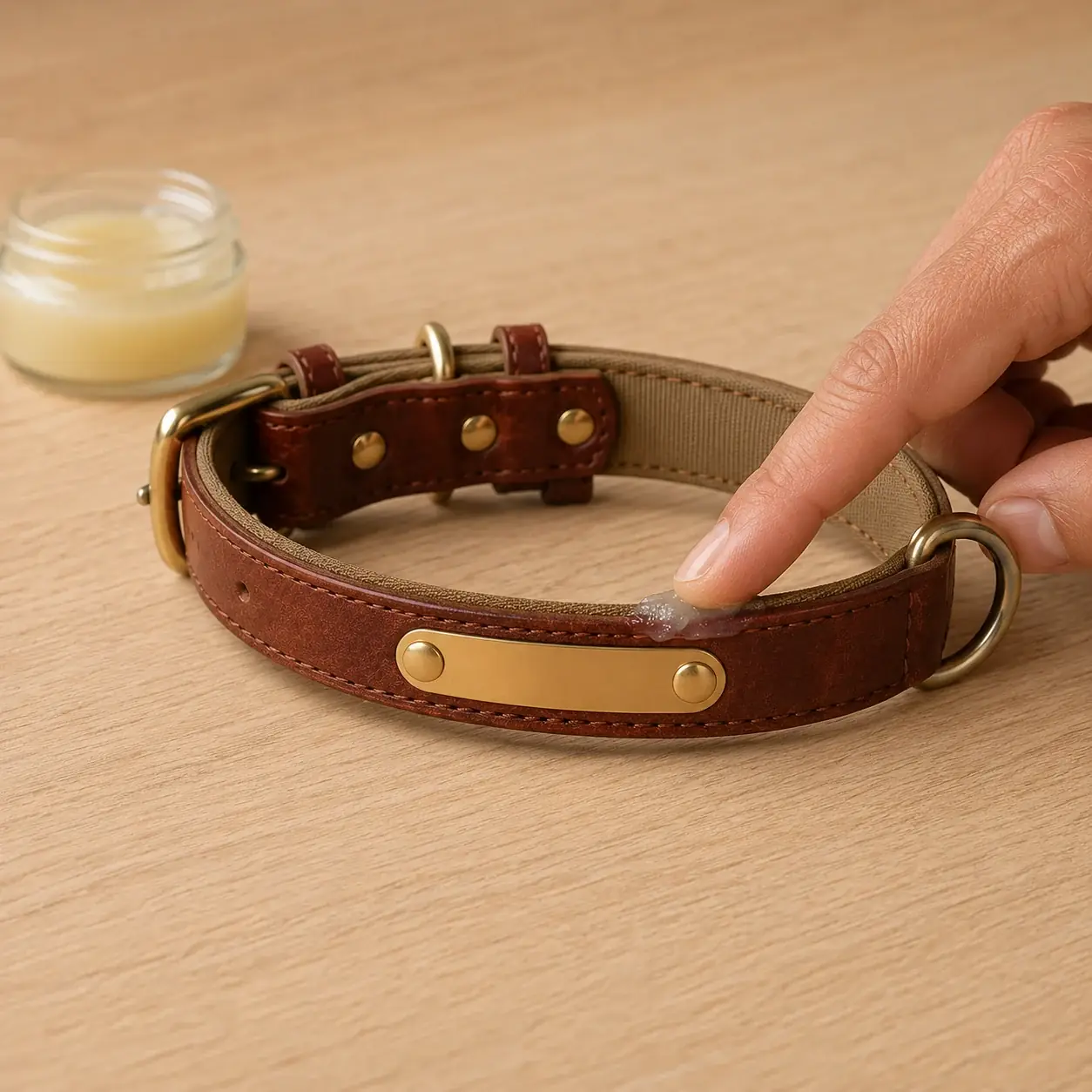
- Condition. A small amount of leather conditioner or balm on a fingertip, worked along the strap in circles until it disappears. Less than you think — leather that looks greasy has too much on it and will pick up dirt faster.
How often
| Dog | Wipe | Condition |
|---|---|---|
| Town dog, pavement walks | Monthly | Every 2–3 months |
| Country dog, mud and fields | Fortnightly | Monthly |
| Dog who swims | After each swim | Monthly, without fail |
| Heavy double coat | Monthly | Every 2 months |
| Puppy under a year | Monthly | Rarely needed before the first size change |
If in doubt, wipe more often and condition less often. Over-conditioning is the more common mistake.
What never to put on it
| Do not use | What it does |
|---|---|
| Household or kitchen cleaner | Strips the finish, leaves the leather chalky |
| Washing machine | Soaks and then tumbles it dry — hard and misshapen |
| Alcohol or baby wipes | Dries the surface, brings on cracking early |
| Olive or vegetable oil | Goes rancid inside the leather. The smell never leaves |
| Radiator, hairdryer, direct sun | Permanent stiffening. Nothing reverses it |
| Saddle soap on a lined collar | Fine on bare leather, hard to rinse out of a lining |
The olive oil row is the one people are most surprised by, and it is the one that ruins the most collars. It works beautifully for a month and then the collar smells, from the inside, with no way to get it out.
After a swim, and after rain
Water on leather is not a disaster. Water left in leather is. The rule is the same for a rainstorm and for a lake: get the surface water off with a cloth, then let it dry slowly and flat, and condition once it is dry rather than while it is damp.
Salt water needs one extra step — a wipe with a cloth dampened in clean water first, to lift the salt, before the drying. Salt left in leather crystallises as it dries and abrades the fibres from the inside.
What you should not do is put a wet collar straight back on the dog. A damp strap against skin for eight hours is how you get the irritation people blame on the leather.
Getting the smell out
A collar worn permanently by a dog will eventually smell of that dog. Two things usually fix it, and neither involves washing.
First, clean the lining rather than the outside. The smell is almost always in the side against the neck, and that surface gets skipped because it is the one you cannot see. Second, give it twenty-four hours off. Most collar odour is trapped moisture, and a day in open air with nothing on it does more than any product.
If it persists, a cloth barely dampened with a very dilute mix of water and white vinegar, followed by a full dry and a condition, will deal with most of it. Anything stronger than that is trading the smell for cracked leather.
The brass
The buckle, D-ring and plate will develop a dull warm patina, and that is the brass doing what brass does rather than a fault. If you prefer it bright, a dry microfibre cloth on the plate takes it back most of the way in a few seconds.
Leave metal polish alone. It gets into the leather along the rivet edge and stains it, and on an engraved plate it fills the lettering with residue — which is the one part of the collar whose job is to stay readable. The plate on our collars is riveted rather than hanging, so it never needs to come off for cleaning.
How long it should last
A collar looked after this way outlives several webbing ones. The parts that actually end a leather collar's life, in order: the holes tearing at the buckle end on a dog who pulls, the stitching going where the D-ring is riveted, and the leather cracking after being dried on a radiator once.
The first two are load. A wider strap spreads the same force over more surface, which is why our sizes step up in width along with neck length — and why a dog who leans on the lead should be in the widest strap his neck takes rather than the narrowest that fits. The third is entirely preventable, and now you know how.
While it is drying
Your dog should not be bare for the two hours the collar is on the table. This is the only real argument for a second collar, and it is a decent one — most households that own two use one as the everyday strap and keep the other for the day the first is drying. Either way, the identification should never be the thing that is off the dog.
If you would rather not own two, an engraved name tag on whatever he wears in the meantime covers the gap. And if you are choosing a first leather collar, the sizing is in the size chart and the fit check is in how tight should a dog collar be.

Dana Whitfield · Curator, Namouf
Dana writes the sizing guidance and the guides on this site.