
· Dana Whitfield
Dog collar or harness? The question is not either/or
The debate is framed as a choice because both things clip a leash. That is the only overlap. One of them is walking equipment that comes off at the door, and the other is the thing your dog is wearing at three in the morning when a gate has been left open.
What a harness genuinely does well
Two things, and they are real. It moves the leash attachment from the neck to the chest or back, which spreads force across a much larger area than a strap can. And on a strong dog it gives the handler more mechanical advantage, because you are working against the body rather than against the neck.
For a dog who lunges, a dog recovering from a neck or throat problem, or a flat-faced breed whose airway is already compromised, that is not a preference. It is the correct equipment, and no argument about collars changes it.
What only a collar does
A harness is taken off. Every household takes it off, because a dog cannot live in one — it traps heat, it flattens coat, and it is uncomfortable to sleep in. That single practical fact decides everything else.
The thing your dog is wearing when he gets out is the thing that has your phone number on it. In an ASPCA survey of 1,015 households published in 2012, only 6% of owners recovered their dog at a shelter — the overwhelming majority were returned by someone nearby who picked the dog up and needed a way to reach a human being. That person reads whatever is on the neck, once, at arm's length.
Which means the question is not "collar or harness" at all. It is simpler than that: every dog needs a collar. Some dogs also need a harness.
Do vets recommend one over the other?
Veterinary advice is consistently conditional rather than general. Where there is a specific reason to keep pressure off the neck — a collapsing trachea, a brachycephalic airway, a cervical problem, a dog who chokes himself on the lead — the recommendation is a harness for walking, without hesitation.
Where there is no such reason, the recommendation is a well-fitted collar and a dog who has been taught not to hang off it. The same veterinary literature is unambiguous on identification: a collar with a legible plate is the fastest route from found to home, and no harness carries one usefully because no harness stays on.
Why some trainers avoid harnesses
This is a genuine professional disagreement and it is worth stating accurately rather than picking a side. The objection is specifically to back-clip harnesses on dogs that pull. Attaching a leash to a dog's back engages the same opposition reflex that sled harnesses are built around: resistance at the back produces forward drive. Trainers who see a lot of pulling see harnesses making it worse.
The objection is not to harnesses as such — front-clip and Y-front designs do not have this problem in the same way — and it is not an argument that a collar teaches anything either. Neither piece of equipment teaches. Both buy control while the training does the work. What actually stops a dog pulling is removing the reward, which we go through in how to stop a dog pulling on the leash.
The dogs where the answer is not a matter of opinion
| Dog | Walk him on | What still stays on |
|---|---|---|
| Flat-faced breed (pug, bulldog, boxer) | Harness | Collar with the plate |
| Collapsing trachea, small toy breeds | Harness | Collar with the plate |
| Strong dog who lunges at things | Harness, front-clip | Collar with the plate |
| Puppy under six months | Either, whichever fits | Collar with the plate |
| Narrow-headed breed who backs out | Harness | Collar with the plate |
| Adult dog who walks on a slack leash | Collar | Collar with the plate |
The right-hand column is the same in every row. That is the point of the table.
The escape artist case, which cuts both ways
A dog who reverses out of a collar is the one case where people conclude the collar is the problem, and it is usually the fit instead. Dogs back out of loose collars, deliberately and skilfully, and narrow-headed breeds are good at it because the skull is barely wider than the neck. A collar you can slide a whole hand under is a collar he will be out of at a crossing.
Fix the fit first — two fingers, flat, at the side of the neck, on a standing dog. If a correctly fitted collar still comes off, that is a real reason to walk him in a harness, and the collar still stays on underneath it, carrying the plate. The full check is in how tight should a dog collar be.
If you use a harness, what the collar should be
A collar worn all day and never pulled on is a different object from a collar you steer with, and it should be chosen differently. Three things change:
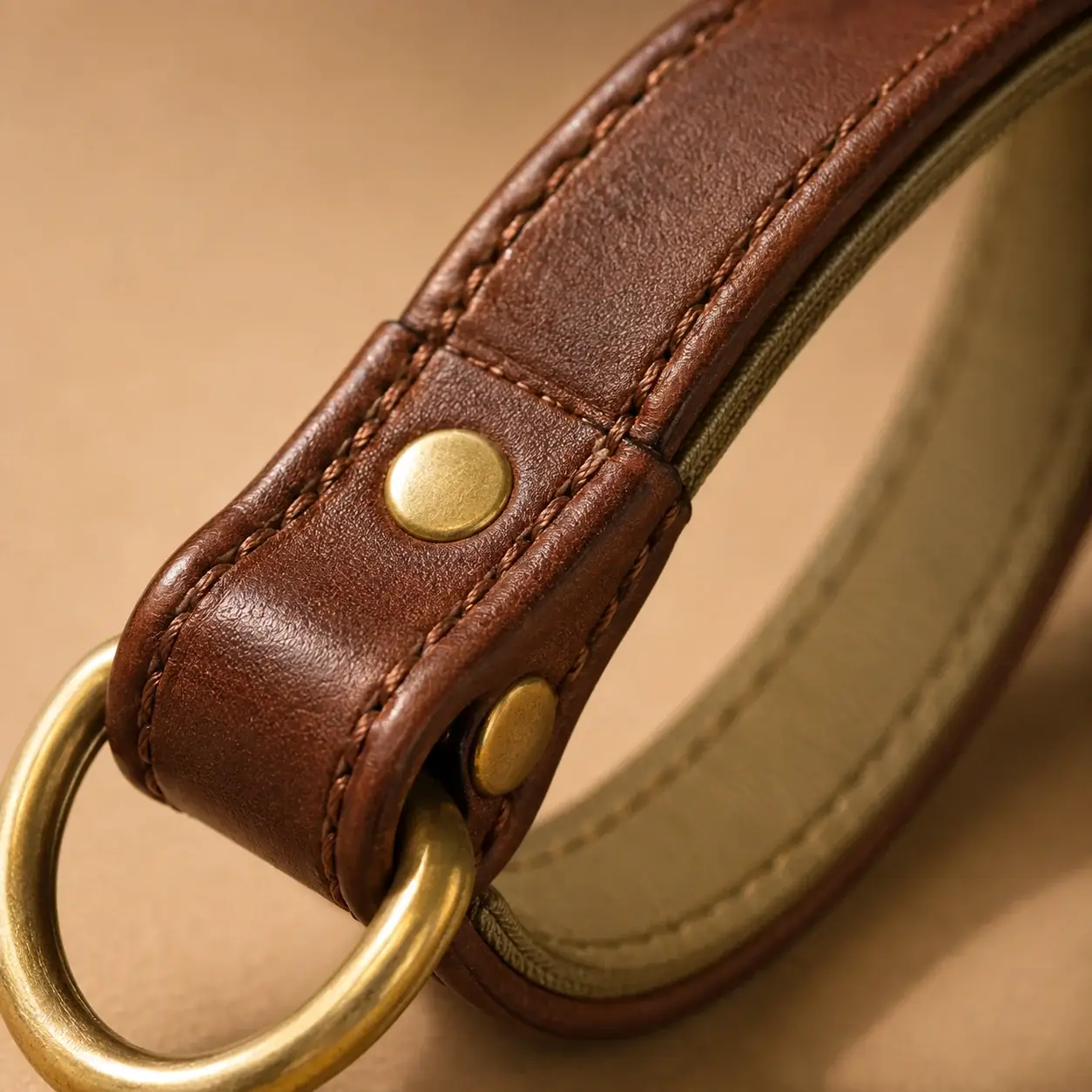
- Lining matters more than strength. Something worn twenty-four hours a day sits against skin the whole time. A padded, lined strap does not chafe the way a raw edge does.
- The plate should be riveted, not hanging. A dangling disc spins, catches on crate wire, and wears its lettering flat against a food bowl. A plate lying flat on the strap is still readable in year five.
- Width still counts. Even without leash force, a wider strap distributes the weight of the collar itself and keeps the plate flatter and more readable.
That is exactly what our engraved leather collar is built for — the collar that stays on, whatever you clip the leash to. If your dog already has a collar he is happy in, an engraved name tag puts the same information on the strap he is already wearing.
Can he wear both at once?
Yes, and it is what most owners of harness-walked dogs actually do without thinking about it. The harness goes over the collar, the leash clips to the harness, and the collar sits underneath carrying the identification. Nothing interferes with anything. The only thing worth checking is that the harness straps are not pressing the collar plate into the neck — if the plate has migrated round to the throat by the end of a walk, the collar is a hole too loose.
The short version
Choose the harness question on the walk: your dog's airway, your dog's strength, your dog's habit of backing out. Choose the collar question on everything else: it is on him all day, it carries his name and your number, and it is the piece that does its job on the one day it matters. Those are two different decisions, and treating them as one is how dogs end up outside with nothing on them.

Dana Whitfield · Curator, Namouf
Dana writes the sizing guidance and the guides on this site.