
· Dana Whitfield
How to stop a dog pulling on the leash
Almost every walking problem is one problem. Your dog has learned that leaning into the leash produces forward movement, and he has learned it several hundred times, on your side of the transaction. No device changes that arithmetic. Only removing the reward does.
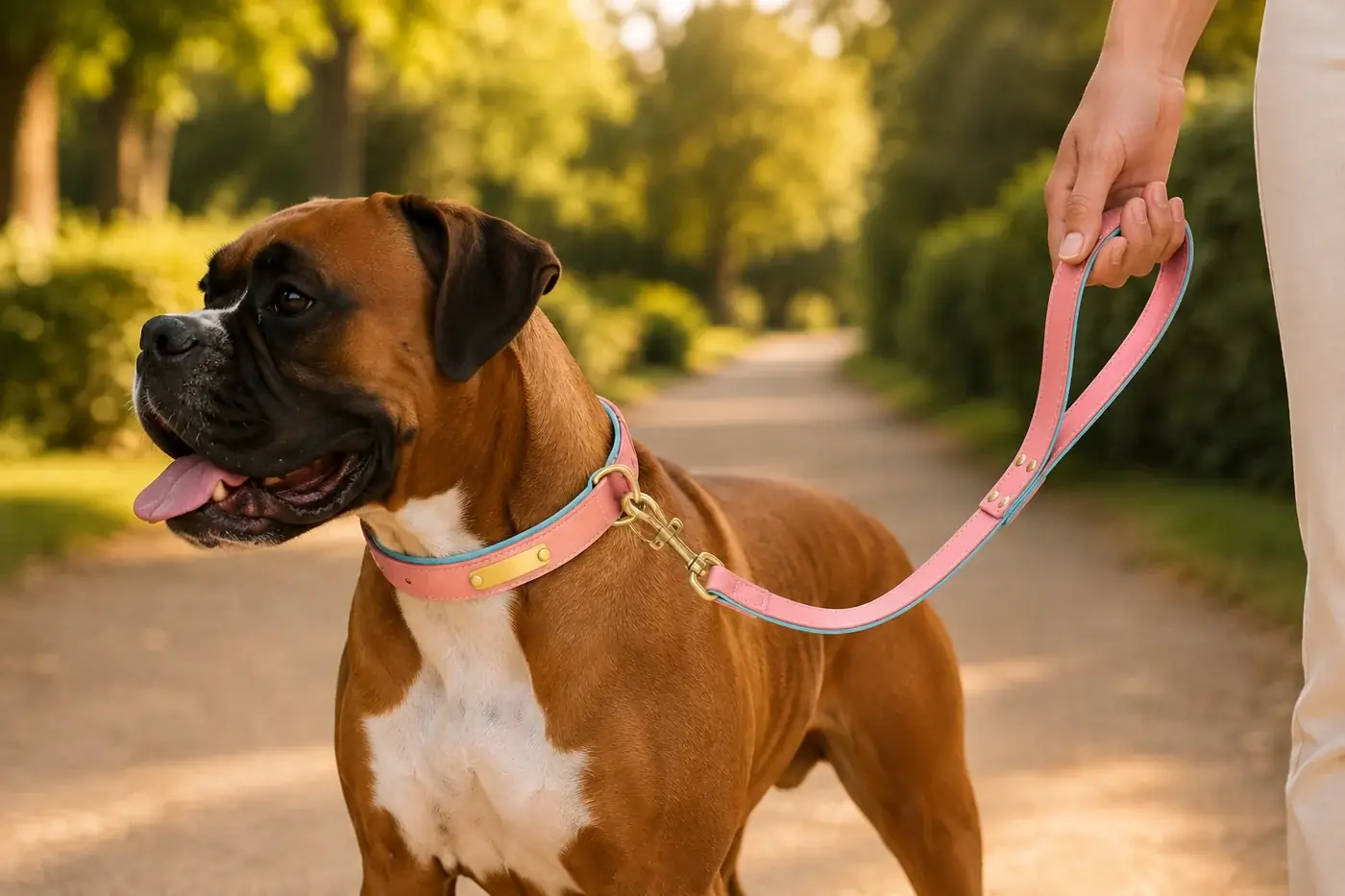
Can you fix it in five minutes?
You can change one thing in five minutes, and it is the only thing you control: your own feet. What you cannot do in five minutes is undo months of a dog being paid for pulling. Anyone promising otherwise is selling the device rather than the result.
What genuinely happens inside the first five minutes, if you do this properly, is that your dog notices the rule has changed. He will test it — harder, at first, because behavior that used to work always gets louder before it stops. That spike is the sign it is working, not the sign it is failing.
The stop-start method, done properly
- Decide where slack ends. Pick a point on the leash and treat any tension past it as tight. Vague thresholds teach vague rules.
- Stop dead the instant it goes tight. Not a tug, not a word. Stand still. You become a post.
- Wait for slack. He will lean, then look back. The half-second the leash sags, say a marker word and step off.
- Move the moment it goes slack, every time. The walk is the reward, so it has to arrive immediately and it has to arrive only then.
- Accept the first three walks will be short. You may cover a hundred yards in twenty minutes. That is a successful walk.
The failure mode is inconsistency, not technique. A dog who is stopped nine times out of ten and dragged along the tenth learns that pulling works occasionally, and intermittent rewards are the hardest of all to extinguish. If one person in the household cannot hold the rule, that person's walks will undo everyone else's.
Why he suddenly started pulling
A dog that walked politely for a year and now hauls is telling you something specific. In rough order of how often it turns out to be the cause:
| Trigger | What you notice | What to change |
|---|---|---|
| Adolescence, 6–18 months | Manners collapse across the board | Go back to short walks and rebuild |
| New route or new smell | Pulls only on one stretch | Work that stretch on its own |
| Under-exercised | Explodes out of the door, settles later | Five minutes of sniffing before you set off |
| Pain or discomfort | Pulls to one side, or resists turning | A vet, before any training |
| New equipment | Started the week something changed | Check the fit before you blame the dog |
That last row is worth taking seriously. A collar that has quietly tightened over a winter coat, or one fastened on its last hole, changes how a dog carries himself on a walk. The two-finger check takes ten seconds and is in how tight should a dog collar be.
Do dogs grow out of it?
No. Puppies grow out of chewing table legs because the underlying drive fades. Pulling has no drive to fade — it is a habit that pays, and it pays a little more every year the dog gets stronger. A twelve-week-old puppy leaning on a leash is a fifty-kilo dog leaning on a leash in eighteen months, with the same rule intact.
This is the argument for starting on the first day the puppy is on a leash at all, when he weighs nine pounds and stopping dead costs you nothing.
How to discipline a dog that pulls
Discipline is the wrong frame for this one. A dog pulling is not defying you; he is doing the thing that has always worked. Corrections aimed at the pulling — jerking back, scolding, tightening — teach him that the leash going tight predicts something unpleasant, which most often produces a dog who pulls anyway and is anxious about it.
What changes behavior reliably is making the alternative pay better. Reward the position you want, at the moment he is in it, rather than punishing the one you do not. In practice: when he is beside your leg on a slack leash, that is the moment something good happens, not five seconds later when he has already moved ahead.
Equipment: what it can and cannot do
Where the leash attaches changes the physics of a pull, and it is worth being clear about what that means. Attaching at the neck puts the force through the neck; attaching at the chest changes the angle and gives you more mechanical advantage over a strong dog. Neither one teaches anything. Both buy you control while the training does the actual work.
Our own position is the same as it is everywhere on this site: the collar is what stays on, and the walking equipment is a separate decision. The collar carries the identification twenty-four hours a day, including at three in the morning when a gate has been left open. What you clip to it on a walk is a question about that dog, that route, and that day. We go through the trade-off in collar or harness.
One thing inside the collar does matter for a dog who leans: width. The same force spread over a broader strap is easier on him than the same force through a narrow one, which is why our sizes step up in width along with neck length. Tightening a narrow collar to compensate makes both problems worse at once.
Leash length changes the walk more than any device
This is the cheapest fix on the page and almost nobody makes it. A leash that is too long lets a dog reach the end of it at speed, which is the exact moment the pull is rewarded. A leash that is too short leaves him no room to be right.
| Length | Best for | Why |
|---|---|---|
| 4 ft | Traffic, vets, crowds | Dog stays at your leg, no run-up |
| 5 ft | Everyday town walking | Slack is reachable without effort |
| 6 ft | Parks and open paths | Room to sniff without hitting the end |
| Retractable | Not for a puller | Constant light tension teaches that pulling is normal |
That last row is the one that surprises people. A leash under permanent slight tension trains the dog that a tight line is simply the state of the world, which is the exact belief you are trying to remove.
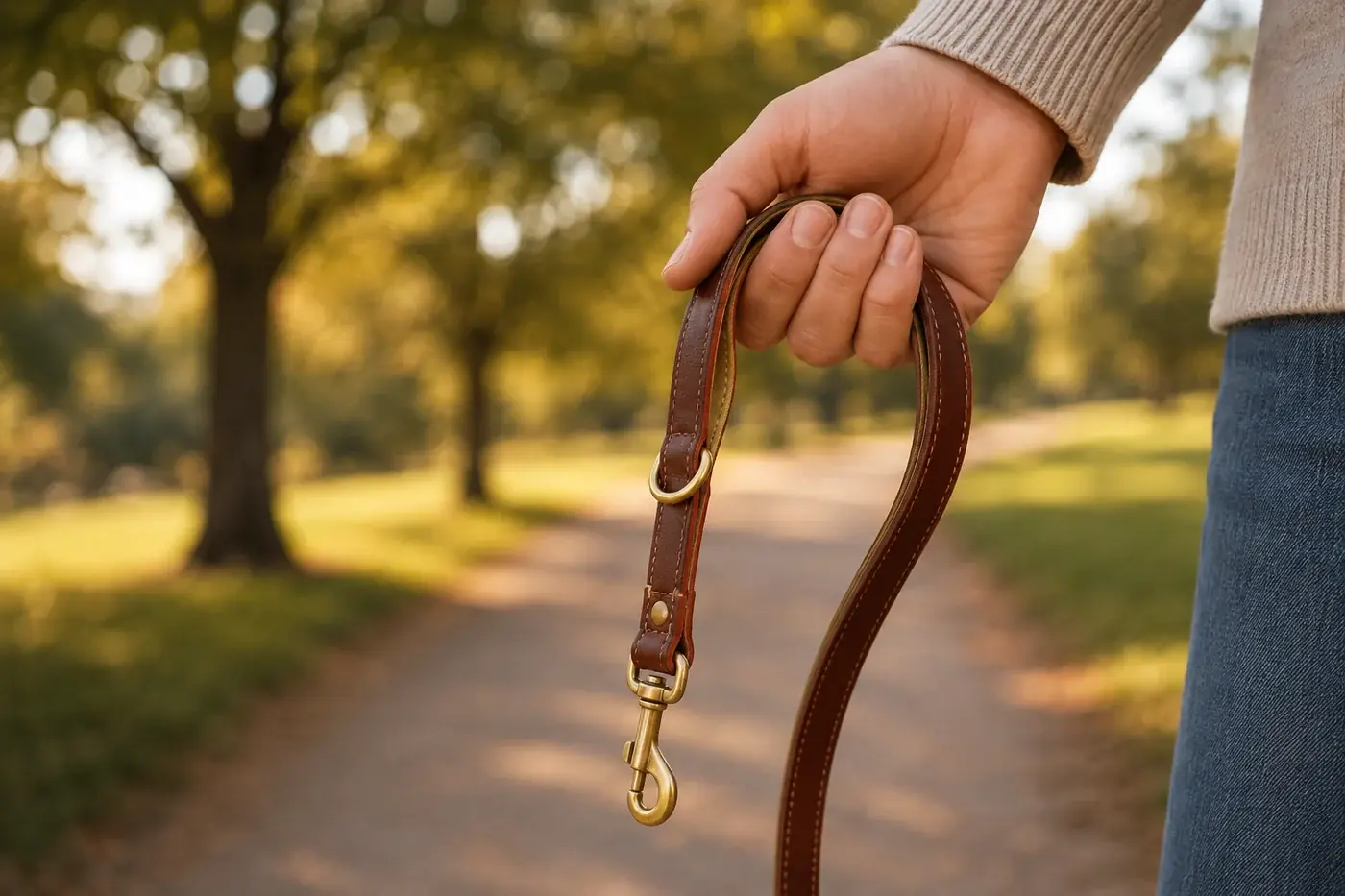
What the leash itself does
A leash cannot train your dog, but a bad one can undo your handling. Three things matter and none of them is the pattern. Weight, because a leash with body hangs in a visible curve, so both of you can see when it is slack. The handle, because you will hold it for an hour and a folded, stitched handle does not bite into your palm the way a webbing loop does. And the hook, because a snap hook is the single point holding everything and it should be solid brass rather than plated pot metal.
Our leather leash is built around those three, and it is the same leather and the same brass as the collars, which is the point of buying them together rather than separately.
The two-week version
Week one: short walks, stop-start held without exception, no destination. Week two: the same route, slightly longer, and start rewarding position rather than just absence of tension. By the end of it most dogs are walking on a slack leash most of the time, which is the realistic target — not a dog who never once tightens the line, but a dog for whom a slack leash is the default and a tight one is the exception.
And keep the identification on him throughout. A dog in the middle of leash training is a dog being handled in new places by an owner who is concentrating on his feet, which is exactly the profile of the dog who slips away. Our engraved collar is what stays on for that.

Dana Whitfield · Curator, Namouf
Dana writes the sizing guidance and the guides on this site.