
· Dana Whitfield
The safest dog collar: types that protect, types to avoid
Ask what the safest dog collar is and most answers talk about padding and stitching. Those are comfort and durability. Safety at the neck comes down to something more mechanical: what the collar does when force arrives — from the leash, from a fence board, from another dog's jaw mid-play. Every type on the market answers that question differently, and the answer is the type.
So this guide sorts the types by one measure: what each one physically does under load, where that behavior protects a dog, and where the same behavior becomes the hazard.
"Safe" is three separate questions
The first question: does it hold its size? A collar with a fixed circumference cannot tighten, whatever happens at the other end of the leash. Types that close under tension trade that certainty away, and their safety depends on where the closing stops.
The second: what happens when it catches? Collars snag — on crate wire, on a branch, on a playmate's tooth. A fixed collar holds and the dog is stuck; a breakaway releases and the dog is loose. Neither behavior is right everywhere, which is why cats and dogs get different answers.
The third: is it on the dog when it matters? A collar that only goes on for walks is not carrying his name at three in the morning when a side gate has been left open. Whatever type you land on, it has to be comfortable enough to stay on around the clock.
These three pull in different directions, and no single type wins all of them. Each type on the market is one way of settling that conflict — and that is exactly why the list below reads the way it does.
The flat collar, fitted properly
A flat collar is a strap of fixed length with a buckle: the loop it makes around the neck stays the same size whether the dog is asleep or hitting the end of the lead at speed. That single property answers the first safety question outright, and it is why the flat collar is the default for everyday wear.
The type alone does not make a dog safe — the fit does. Fitted to the two-finger rule, a flat collar cannot be backed out of and leaves no slack for a jaw or paw. Fitted loose, it becomes the most common collar failure there is: a dog reversing out of it at a crossing. Loose, not tight, is the dangerous direction.
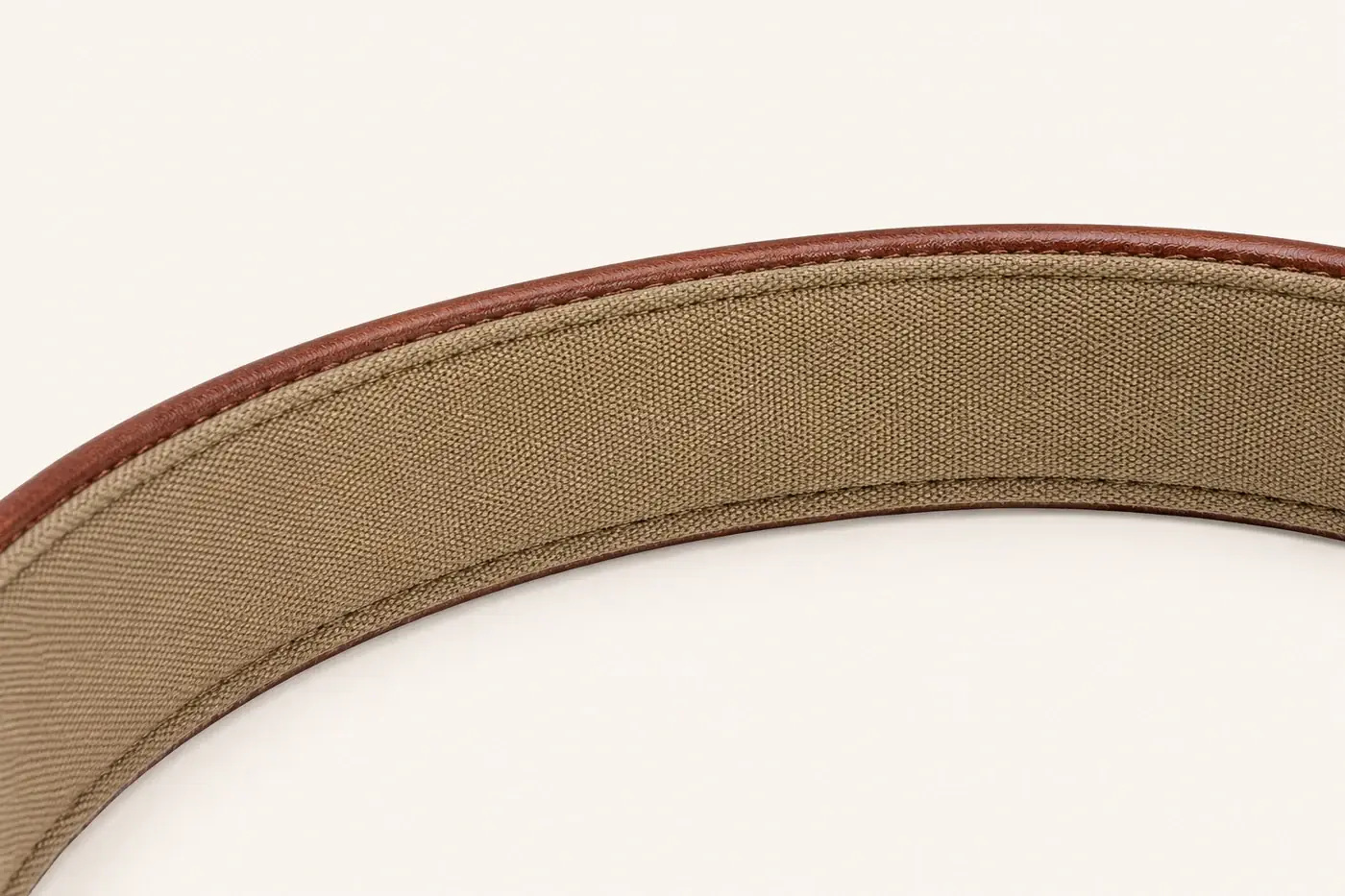
Material and width do the rest of the work. A wider strap spreads the same pull over more surface, which is why our sizes step up in width as necks get longer, and a leather strap with a padded lining keeps that pressure off bare skin day after day. If you are between sizes, the size chart settles it neck by neck; for a puppy growing into his first one, the first-year guide covers when to move up.
The martingale: a slip with a stop
A martingale is two loops: a large one around the neck and a small one the leash clips to. When the dog pulls, the small loop draws the large one tighter — until the small loop's ends meet and the closing stops. That built-in stop is the whole design. Adjusted correctly, a martingale at full close is simply a snug flat collar; it cannot keep constricting past the point you set.
It exists for one body shape: dogs whose heads are barely wider than their necks — greyhounds, whippets and similar builds — who can slide a properly fitted flat collar over their ears in one backward step. For that shape, it closes just enough to stay on, exactly when the dog tries to leave it.
Its two failure modes are both fit. Set with too much slack, the stop sits past snug and it behaves like the limitless loops in the next section. And because the relaxed collar hangs looser than a flat, a martingale left on an unsupervised dog gives a hook or a tooth more to catch. It is walking equipment for a specific silhouette: for most dogs, a properly fitted flat collar does the same job with no moving parts.
The breakaway: built to let go
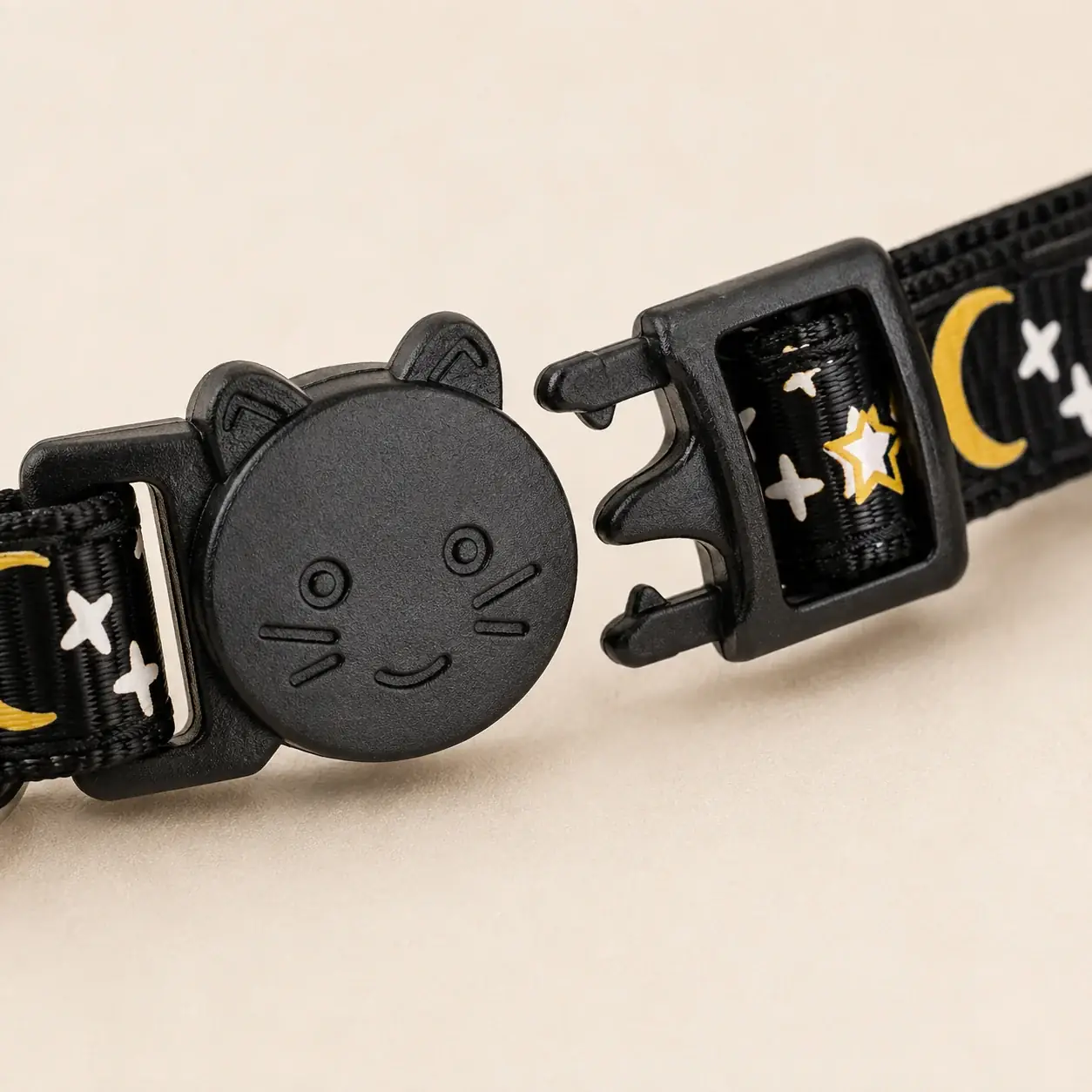
A breakaway collar inverts the logic of every other type: its buckle is engineered to open under a hard load. Snag it on a branch and it does not hold the animal — it releases him.
For cats, that behavior is the standard answer, and the reason is how cats move: through hedges, up trees, across fence tops, anywhere a collar can hook with the cat's full weight behind it. A cat collar that holds under that load is a trap; one that lets go is not. That is the entire safety case for our breakaway cat collar, where the buckle, not the strap, is the part that matters.
The same release is exactly why the breakaway is not the default dog collar. A collar that opens under load cannot take a leash: the first real pull would unclip the dog from you, in traffic, at the moment you most need the opposite. Dog versions solve this with a second pair of rings that bridge the buckle for walks — which works, provided whoever clips the leash knows the rule every time.
The breakaway is a deliberate trade: retention given up to rule out strangulation. Right for cats, and for a dog in one narrow setting — group play — covered two sections down.
Collars that tighten without a limit
A slip collar — the chain version is usually called a choke chain — is a loop that closes for as long as there is tension, with nothing built in to say stop. Every pull, whether the dog's lunge or the handler's correction, converts directly into a smaller circle at the neck. Release the tension and it loosens; keep it and it keeps closing.
As training equipment, everything rides on the handler: the loop only works as intended sitting high on the neck, with tension that is brief and released instantly. Held taut, or on a dog that leans into it, the pressure sits continuously on the front of the throat — the softest part of the neck takes the load.
As an everyday collar it fails the first question outright: it has no size to hold. A slip loop left on an unattended dog turns any snag into a closing circle, with the dog's own weight supplying the tension. It also gives an engraved plate no fixed place to live, so the identification job goes unfilled too. Whatever position you take on it as a training tool, it is not a collar in the wearing sense of the word.
Prong and electric: what they actually do
A prong collar is a chain of hinged metal segments, each carrying two blunt points angled in toward the neck. Where a flat strap spreads leash force across its width, the prong concentrates it onto the points, so tension at the neck becomes something the dog works to avoid. That is not a side effect; it is the mechanism.
An electric collar is a strap carrying a box with two contact posts against the throat, delivering a tone, a vibration or a static pulse — triggered by a handheld remote, or automatically by a bark sensor. Like the prong, it works by adding something the dog wants to stop, and its effect depends entirely on the timing and judgement of whoever holds the remote.
Both are session tools built around supervision; this article is about what a dog wears all day. Measured as collars they answer none of the three questions: points and contact posts are not made to sit on the same patch of neck around the clock, neither carries a name, and neither is left on and forgotten. A dog that pulls hard enough to make either one tempting is usually better served by where the leash attaches — that trade-off has its own guide.
The dog park question
The collar accident owners actually witness is not a car or a fence. It is two dogs playing, mouth-first at each other's necks, and a lower jaw slipping under a collar. The caught dog panics and spins; the twist tightens the strap on one neck and traps the jaw of the other. It happens fast, in front of everyone, at the friendliest parks.
The variable that decides it is slack. A jaw cannot pass under a collar that admits two fingers; it passes easily under one that admits a hand. Every loose collar at a dog park is carrying this risk on top of the escape risk it already had — and a slip or martingale worn into group play adds a closing mechanism to the same accident.
Some daycares and play groups ask for collars off or breakaway-only during sessions, and inside a fenced, supervised space that logic holds: for that hour, the humans present are the identification. The rest of the day is not that setting. The working answer is a flat collar snug to the two-finger line, checked whenever his weight or coat changes — tight enough to leave nothing to hook, and on him when a gate is open and nobody is watching.
Hardware: the part everyone skips
Two collars of the same type can behave very differently under load, and the difference is the hardware. The closure comes first: a metal tongue through a punched hole is either fastened or it is not, and it cannot creep to a looser setting as the dog wears it. Whatever the closure, the test is the same: the size you set is the size it keeps.
Every leash force lands on the D-ring, so how it is fixed to the strap matters more than how it looks. Riveted through the leather, it loads the strap itself rather than a line of thread. The same goes for identification: a plate riveted flat to the strap, like the one on our engraved collar, keeps the name readable at the side of the neck instead of migrating under the throat on a rotating strap.
None of this replaces fit. It just decides whether a correctly fitted collar is still the same collar six months of pulling later.
The short version
| Type | What it does under load | Where that is the safe behavior |
|---|---|---|
| Flat collar | Holds its size | Everyday wear, on lead and off — the default |
| Martingale | Closes to a preset stop | Walks, on narrow-headed dogs that slip flat collars |
| Breakaway | Releases the animal | Cats, always; dogs in supervised group play |
| Slip / choke chain | Keeps closing while tension lasts | Only in a handler's hands, briefly — never worn unattended |
| Prong | Concentrates force onto points | A supervised session tool, not an all-day collar |
| Electric | Adds a remote stimulus | Same — nothing about it is built for around-the-clock wear |
Read down the middle column and the pattern is plain: the safest types are the ones whose behavior under load needs no supervision. A flat collar fitted to two fingers protects by doing nothing — no closing, no releasing, no correcting — while carrying a name every hour of the day. The types to avoid as collars are the ones that only behave when someone is holding the other end.

Dana Whitfield · Curator, Namouf
Dana writes the sizing guidance and the guides on this site.