· Dana Whitfield
Leather vs nylon dog collar: what each one does in a year of wear
Almost every comparison of these two materials is written about the day you buy the collar — the least interesting day. A collar is bought once and then worn for something like a thousand days — through rain, mud, molting season, a growth spurt if the dog is young, and several hundred hours on the end of a lead.
What actually separates them
Strip away the appearance and the two materials answer one question differently: does the strap change, or does the dog?
Nylon webbing is woven and dimensionally stable. The strap you take out of the box is the strap you will have in three years, minus some fading: there is nothing in a woven synthetic that takes a set.
Leather is a sheet material that flexes at the same two or three points every single day — where it curves at the throat, where it turns through the buckle. Those points soften first, and the strap gradually stops being a straight band and becomes a ring shaped like that particular neck.
| Over a year of wear | Nylon webbing | Leather |
|---|---|---|
| Shape | Unchanged | Takes the curve of the neck |
| After a swim | Goes back on wet | Wipe, dry flat, then back on |
| Odor | Held in the weave | Sits on the surface |
| Adjustment | Slides on a ladder or a keeper | Pinned in a punched hole |
| Failure | Thread and hardware, suddenly | Strap and holes, visibly |
| Upkeep | Wash it | Wipe, dry, condition occasionally |
Day one and day four hundred
On day one, nylon is the more comfortable of the two: soft out of the packaging, no break-in, and a dog who has never worn a collar notices it slightly less. That head start lasts about two weeks.
By day four hundred the picture has inverted. Nylon on day four hundred is the same band it was on day one — the same flat cross-section, meeting the neck at the same angles, pressing at the same two edges. Leather by then has stopped being a band at all. It holds a permanent curve, the throat section is thinner and more pliable than the rest, and the buckle end has learned the hole it lives in.
That is why leather is the traditional answer for a collar that never comes off, and the reason is mechanical rather than nostalgic: a strap shaped like the neck spreads its load across the whole contact surface, while a flat band concentrates it along two edges every day for years.
Water, mud, and the dog who swims
This is the section where nylon has the simpler answer, and it deserves stating outright.
Nylon takes immersion with no procedure at all. A dog can go into a lake, come out, shake, and keep the collar on, and nothing about that sequence damages the webbing. Mud rinses out under a tap, and when it gets bad enough the strap goes in the wash. For a dog who is in water several times a week — the retrievers, the spaniels, the dog with a river at the end of the garden — that is less to think about.
Leather asks for about a minute in return. Surface water comes off with a cloth, the strap dries flat and away from heat, and it gets conditioned once it is dry. Salt water needs one extra wipe with clean water first. The full routine is in how to clean a leather dog collar.
What is left out of most comparisons is what happens after the water, at the neck. Woven webbing holds moisture inside the weave and holds it against skin, which is where collar odor comes from and, on a thick-coated dog, where damp fur stays damp longest. Leather sheds water from a sealed surface and dries from the outside in. So the material that needs no drying routine is also the one that spends longer wet against the dog, and the material that asks for a minute is dry again by the evening.
Neither fact cancels the other, and the last section settles which one governs your dog.
Fur, friction and the skin underneath
A collar is in contact with fur for every hour it is worn, and the two materials abrade it differently.
Nylon is woven, so its surface is a texture rather than a plane. On a short-coated dog that is unremarkable. On a long or double coat it catches individual hairs at the weave and works them, which over a season is the classic ring of broken guard hairs under a collar. It is cosmetic rather than harmful, but it is what gets noticed on heavy-coated breeds.
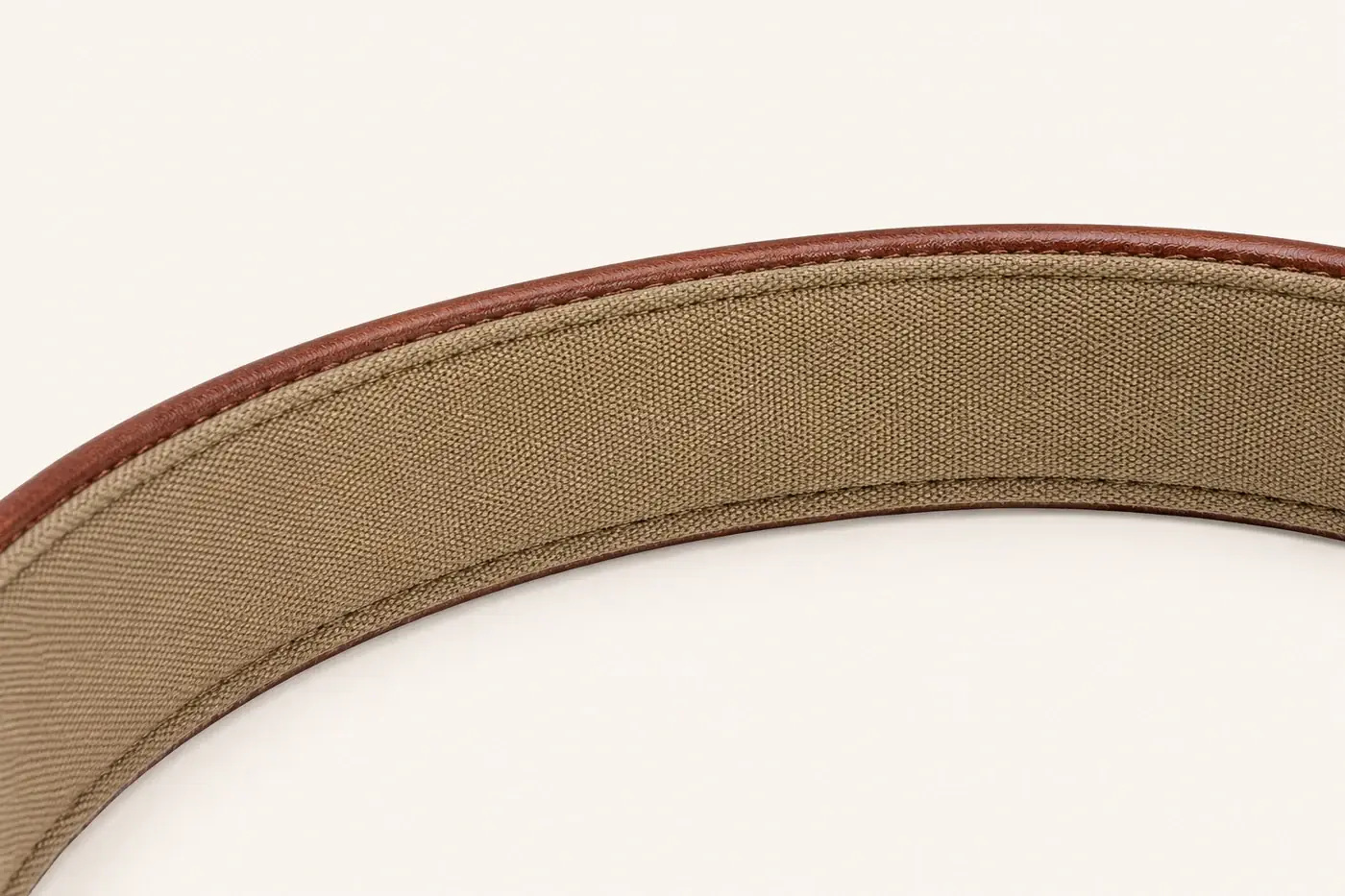
Leather presents a continuous surface, so there is nothing for a hair to catch in — it slides. The trade is at the edge: a cut edge on a stiff strap is firmer than a woven one, which is why a lining matters more on leather than on webbing. The lining is the part actually touching the neck, and the part skipped whenever people talk about materials.
The other half of this is fit rather than material: a collar a finger too loose rotates, and a rotating strap rubs somewhere new every hour. That drives more neck irritation than either material does, and it is covered in how tight should a dog collar be.
How each one fails
Both materials end their life. What separates them is how much warning you get.
Nylon fails at the thread and at the hardware. The webbing itself outlasts almost everything, so what actually goes is the stitched loop holding a D-ring, or the plastic of a side-release buckle after enough seasons of cold and sunlight. Both give way from full function to no function with very little in between, and neither looks any different the day before.
Leather fails at the strap and at the holes. The buckle hole in daily use elongates, the strap thins where it turns, and the surface cracks if it has ever been dried on a radiator. All three are visible for weeks or months before they matter, which means a leather collar tends to get replaced on a schedule you choose rather than on a walk.
Neither is dramatic on a well-fitted everyday collar. What differs is whether looking at it tells you anything, and on leather it does.
Hardware sits underneath both. A D-ring riveted through the strap loads the strap itself; one held by a line of stitching loads the thread. That is a fixing question rather than a material one, and it is the part of collar safety most often skipped.
The adjustment, and why it drifts
This is the difference nobody mentions and everybody eventually meets.
Nylon adjusts by sliding webbing through a ladder-lock or a keeper. It is fast, it is continuous, and you can set it anywhere. It also relies on friction to stay where you put it, and friction changes — the webbing softens, it gets wet, the dog pulls. A nylon collar that was set correctly in spring is often a finger looser by autumn, and the drift is gradual enough that nobody notices the day it happens.
Leather adjusts by pinning a buckle tongue into a punched hole. The settings are discrete rather than continuous, so you are choosing between fixed positions rather than anywhere on a range. Once pinned, it cannot creep: the hole is a mechanical stop, not a friction one. Where the collar sat this morning is where it will sit next month.
The consequence runs the same way for both: check the fit rather than trusting it, because a collar that has gone slack rotates, and a rotated plate faces the fur instead of the world. Measuring first puts the fixed positions where you want them — the size chart takes a minute.
What it costs across the years it is worn
The sticker is the smallest part of this. What a collar costs over a dog's life is the sticker multiplied by how many of them you buy, and the two materials get replaced for different reasons.
What puts a second collar on the list, whichever material you picked:
- The dog outgrew it. Unavoidable in the first year, and it happens more than once. This is why buying a puppy collar big is the wrong economy, which is the whole argument in choosing a puppy collar.
- The hardware went. A buckle or a ring is the end of that collar regardless of how much strap is left.
- The engraving stopped being true. A changed phone number retires a plate. This is the one you can design around: a plate that carries a cell number you keep rather than a landline you might not.
- It stopped being pleasant to handle. Rarely stated, frequently decisive, and it arrives sooner on a strap that has been washed repeatedly.
Against that list, our leather straps are the same price in every color, with one step between the smaller sizes and the larger ones. What you are managing over ten years is the number of collars, and the material that ages slowly and visibly is the one you replace on your own schedule.
Which one for which dog
Here is the criterion, and it is not the one most comparisons reach for: ask how many hours a day the collar is on the dog. That number, not breed or budget, decides which of the differences above you will ever meet.
If a collar only goes on for the walk, the material is doing very little. Nothing is worn long enough to take the shape of a neck, nothing is carrying identification because the dog is beside you the whole time, and the only property in play is how it handles a lake. That is the narrow case where woven webbing answers everything asked of it — and it is why our cat collar is printed nylon webbing, since light, washable and soft under a chin is the entire brief for a cat.
For a collar that stays on, the material is the whole question. It has to hold a shape against one particular neck for years, dry out between soakings, keep a plate riveted flat where a stranger can read it, and show its age before it gives way rather than after. Leather is what answers that list end to end, which is why it is what we put on the engraved collar.
The dog who swims most weeks is not an exception. He adds a minute to the days he swims, and the household where that is most days keeps two straps and rotates them — one on the dog, one on the table drying. That is the standard arrangement in wet country, and the care routine arrives at it from a different direction entirely.
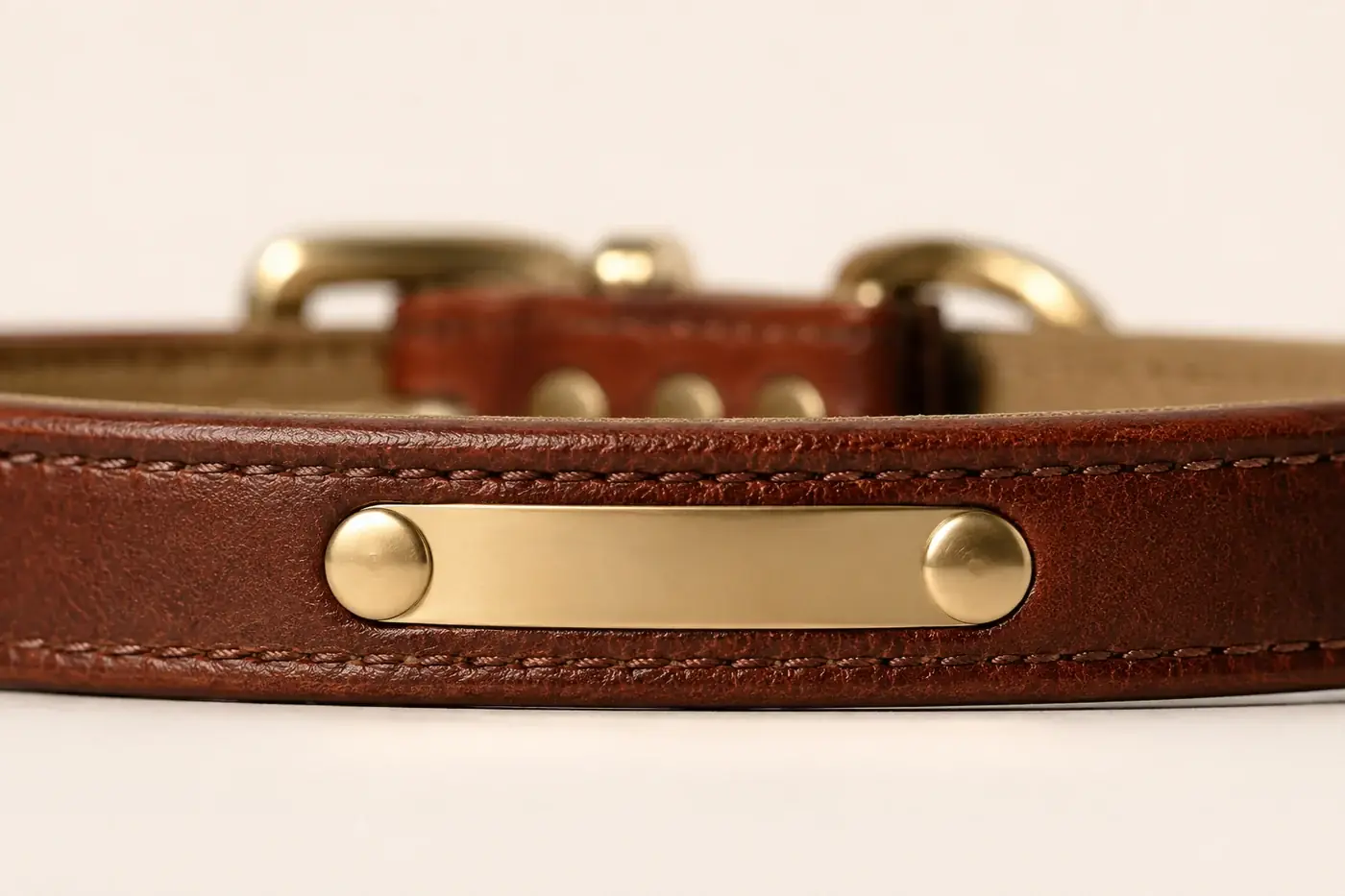
One thing sits outside the choice. Whatever the strap is made of, the identification has to be readable by a stranger holding your dog, and a riveted plate does that in a way a swinging tag does not. On a collar you already own, an engraved name tag puts the same information on it today.
The short version
| If your dog | The material that suits | Because |
|---|---|---|
| Swims most weeks | Leather, and a second strap | One dries flat while the other is worn |
| Wears it around the clock | Leather | It takes the shape of that neck |
| Has a long or double coat | Leather | A continuous surface does not catch guard hairs |
| Is still growing | Either, bought to today's neck | Both get replaced before either wears out |
| Pulls on the lead | Leather, in the widest strap his neck takes | Width spreads the same force further |
| Carries a plate | Leather | Rivets need a substrate that holds them |
Read down that middle column and the pattern is the one this whole guide keeps arriving at. The material question only becomes interesting once the collar stays on the dog — and once it stays on, every row points the same way. Leather is the answer to the ordinary life: the collar that goes on at twelve weeks and is still on him at eight, carrying a name and a number that a stranger can read at arm's length.

Dana Whitfield · Curator, Namouf
Dana chooses what goes in the catalog and writes the sizing guidance. When two sources disagree about a measurement, the call gets made here, and the number that goes on the page is the conservative one.